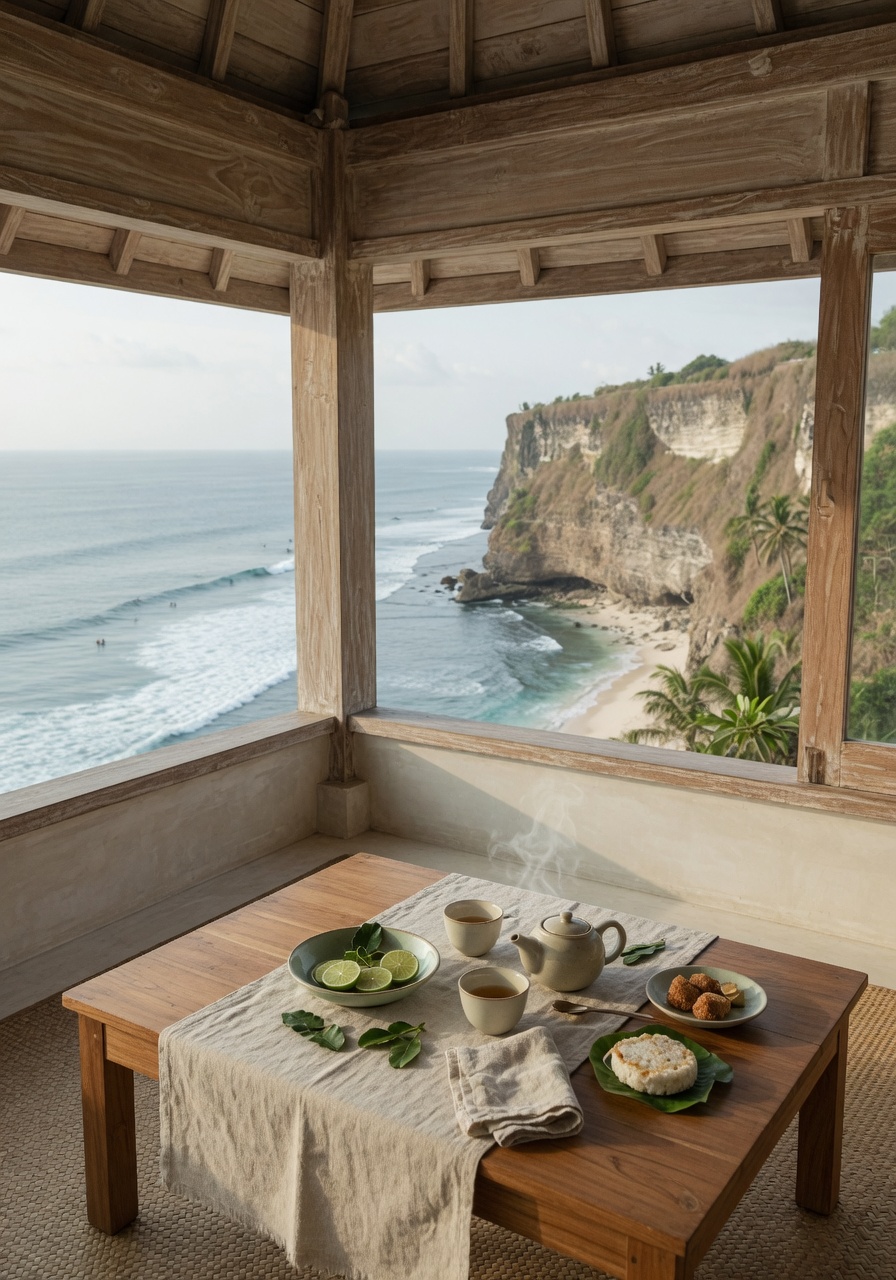
A two-bedroom house above Padang Padang, built around a single open tea room and an aged *shēng* (生) cellar. Held in residence by Amgalan Chin.
A small house held around one tea room
Villa Mengsong sits on the second tier of cliff above Padang Padang, far enough back from the edge that the surf reads as a steady low frequency rather than a view to be photographed. The house was built as a single gesture — one open tea room facing west, two private bedrooms tucked behind it, and a shaded cellar dug into the rock below. There is no third bedroom, no media room, no second living area. The floor plan is the argument.
You enter through a teak door set into a limewashed wall and the room opens at once. A low table of old ironwood runs along the western side, oriented not for the sunset but for the slant of late-morning light that falls through a single tall window. The tea master, Amgalan Chin, chose the orientation himself during the build. He wanted the leaf wet at the hour the light is softest, when the steam off a gàiwǎn (盖碗) lid shows clearest against the wall. The wall behind the table is left rough, finished only with a thin layer of lime — it holds the warmth of the day until well after dark.
The two bedrooms behind the tea room are deliberately small. Each holds a low platform bed, a stone basin, a linen wardrobe, and a window facing the inland garden — frangipani, a single mature kamboja, and the back of a neighbouring compound wall. The intention is that you do not spend hours in the bedroom. You sleep there, you wash, and you return to the tea room, which is where the house actually lives.
Downstairs, cut a metre into the cliff, is the cellar. Amgalan keeps roughly forty cakes here — mostly aged shēng from Bulang and Yiwu, with a smaller shelf of shú (熟) and a few Liu Bao baskets brought down from his own working stock. The cellar holds at around 72% humidity year-round; Bali does most of the work, and a single dehumidifier handles the wet season. Guests are welcome down with the master, never alone — not out of secrecy but because the cakes are catalogued in a way that only makes sense to him. He writes about the cellar’s ongoing development on puerh.app, and several of the younger cakes here are tracked openly in the constellation’s aging database.
Amgalan’s daily routine sets the rhythm of the stay. He rises before five, walks the cliff path to the small warung at Suluban for kopi, and is back at the table by six-thirty. The first session of the morning is private to him — usually a young shēng he is observing, sometimes a Liú Bǎo (六堡) he is comparing against last year’s notes. Guests join from eight onwards, either at the long table or carrying a small tray to the western terrace. He breaks at midday, sleeps through the heat, and returns at four for the long afternoon session that runs into early evening.
The house sleeps four, with a maximum tea room capacity of four — meaning that whoever stays is also the entire session. There is no rotating in of outside guests, no afternoon drop-ins from a neighbouring villa. This is the reason for the no-children-under-twelve policy: the tea room is the living room is the dining room, and the rhythm of three or four sessions a day depends on it staying quiet.
Uluwatu around the villa is its own argument. The cliff road thins out a few hundred metres past the gate, and the walks Amgalan recommends — down to Nyang Nyang at low tide, along the back path to Thomas Beach — are the kind that take a full half-day if done properly. He keeps a small selection of cold-brew flasks for these, prepared the night before from white tea and a light Phoenix oolong. The kitchen, run by a local cook three days a week, leans Balinese-Javanese with restraint — grilled fish, sambal matah, rice from a single Tabanan grower. Wine is available on request but is not the point of the house.
What is served, and how
The tea programme at Villa Mengsong is built around Amgalan’s specialty — aged shēng and shú pǔ’ěr (普洱) — but it is not exclusively pu-erh. A typical week moves across four or five categories, with the master reading the weather and the guests before deciding the morning’s leaf.
Mornings tend toward lighter tea. A Bái Háo Yín Zhēn (白毫银针) from northern Fujian is often the first pour, sometimes a Mí Lán Xiāng (蜜兰香) Phoenix oolong when the air is heavier and the cliff is in cloud. These sessions are short — six to ten infusions, finished by mid-morning. The water is from a single spring source in Bedugul, delivered weekly and held in unglazed jars in the cellar.
The core sessions are in the afternoon, beginning at four. This is when the cellar opens. Amgalan typically pulls two cakes — one younger shēng between eight and fifteen years, and one older piece, usually a Bulang or Yiwu in its third decade. He brews side by side, in matched Yixing pots that he has kept dedicated to each category for years. Guests sit at the low table; he narrates only when asked. The session can run two hours or four, depending on what the leaf is doing.
Once or twice a week he runs a shú and dark-tea session — a Wò Duī (渥堆) shou from his own working selection, a Liú Bǎo basket tea, sometimes a Hunan Fú Zhuān (茯砖) with its golden flowers. These are evening sessions, served after the light has gone, with a small charcoal brazier on the terrace for water. They tend to be the quietest sessions of the stay.
Guests who want to go deeper can arrange a cellar walkthrough, in which Amgalan opens four to six cakes in sequence and talks through what aging in equatorial humidity does differently than aging in Kunming or Guangzhou. This is the same material he teaches in his short-form modules on tea.school, and several of the cakes he discusses are available through shop.puerh.app for guests who want to continue the line at home.
There is no fixed menu, no printed tea list, no upsell. The leaf for the week is decided on the Sunday before arrival, and adjusted day to day. If a guest asks for something specific — a particular vintage, a comparison tasting, a tea they read about on thetea.app — Amgalan will accommodate where the cellar allows, and decline honestly where it does not.
Amenities
-
Open tea room with single ironwood table, seating four
-
Aged shēng and shú cellar with circa forty cakes, climate-controlled
-
Two private bedrooms with low platform beds and stone basins
-
Western terrace facing Padang Padang, partial ocean view
-
Bedugul spring water delivered weekly, held in unglazed jars
-
Local cook three days per week, Balinese-Javanese kitchen
-
Cold-brew flask service for cliff walks and beach days
-
Dedicated charcoal brazier for evening dark-tea sessions
-
Driver on call for Uluwatu, Bingin, and Padang Padang
What’s included
-
Three to four tea sessions daily with Amgalan Chin in residence
-
One cellar walkthrough per stay, by arrangement
-
All tea, water, and ware — no per-session or per-cake charge
-
Breakfast and one cooked meal on kitchen days
-
Airport transfer from Ngurah Rai on arrival and departure
-
Curated reading list and notes shelf, including titles from teamotea.com