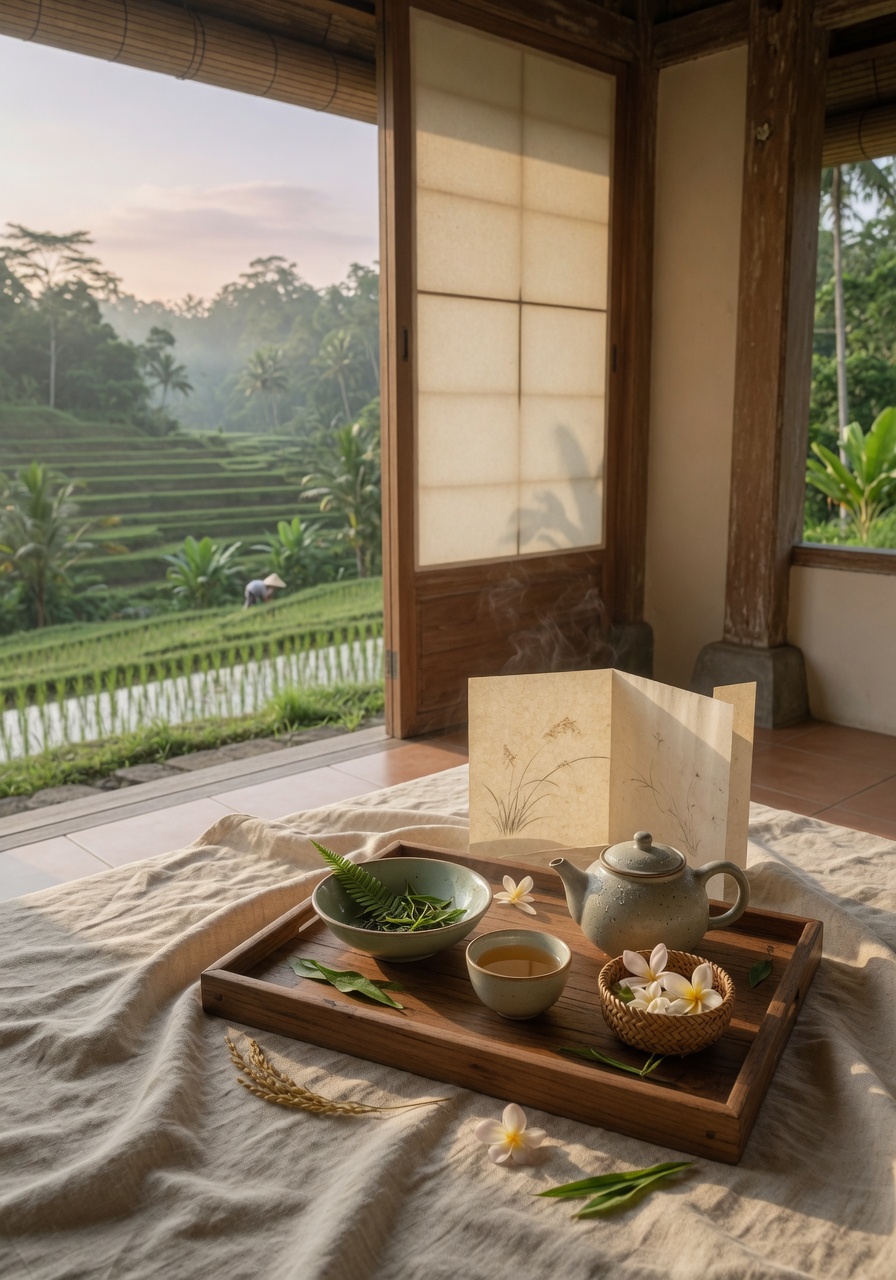
A teak-and-paper house above the Petanu river, built around a fifteen-mat tea room and a twelve-cake cellar — with Amgalan Chin in residence for two morning sessions of every stay.
A house built around its tea room
Villa Yiwu sits on a slow bend of the Petanu river, twelve minutes north of central Ubud, where the road thins to a single lane and the rice terraces fall away on both sides. The house was finished in 2022 by a Balinese-Japanese studio working from a single brief — that the tea room come first, and everything else arrange itself around it. The result is a low teak structure on stilts, three bedrooms wrapped around a central fifteen-mat room, the whole building oriented east so that the first hour of light enters through paper screens onto the tea master’s mat.
You arrive through a small courtyard of moss and river stone. Shoes come off at a long bench of recovered ironwood — the staff will have set out cold towels and a glass of cucumber water, but no one will rush you through the doorway. The entry hall is deliberately narrow, a Japanese borrowing, so that the volume of the tea room when it opens feels like an exhale. Tatami is laid over a raised platform of black-stained teak. The tokonoma alcove holds, on the day of your arrival, a single stem of heliconia in a Jian-ware vase and a hanging scroll in cǎo shū (草书) cursive — borrowed, the master will tell you on the second morning, from a friend in Kunming.
The three bedrooms each open through sliding screens onto a private veranda. Beds are low platform beds with linen from a small mill in Karangasem; bathrooms are open-air, walled in volcanic stone, with copper rain heads and a separate soaking tub of hinoki. The principal suite has its own small tea corner — a side table, a clay kettle, a tin of everyday shòu chá (熟茶) for the hour before sleep. Wi-fi is present but routed away from the tea room itself, which has no electrical outlets at all. The kitchen is run by a private chef who comes in for breakfast and, on request, for a quiet dinner of Balinese vegetables and river fish; lunches the house tends to leave to you and to Ubud’s warungs.
Amgalan Chin is in residence for the duration of every booking. He keeps a cottage at the far end of the property, beside the cellar, and his rhythm — five-thirty rise, a walk along the paddy bund, the first kettle on at six-forty — sets the rhythm of the house. He leads two formal sessions per stay, usually on the first and the last mornings, and is available between them for informal pours, questions about a particular cake, or a slow conversation about the trade routes that once carried Yī Wǔ (易武) leaf north from Yunnan into Buryatia and Mongolia. Amgalan writes regularly on puerh.app about aging dark tea in tropical climates — Villa Yiwu is, in part, his working laboratory for that subject, and guests who are curious are welcome in the cellar.
The surrounding land belongs to a cooperative of three families who farm two crops of rice a year on the terraces below the villa. From the tea room you watch them at work; from the upper deck, at dusk, you watch egrets settle into the palms along the river. The rainforest proper begins eighty metres past the property line, and the staff can arrange a guide for the Campuhan ridge walk or a driver into Ubud for the Saraswati temple and the bookshops on Jalan Hanoman. Most guests, by the third day, find they have stopped going out — the house, the river, the cellar, the master’s quiet presence at the kettle, are enough.
For longer journeys, the concierge coordinates with tea.travel for onward stays in Yunnan or the Wuyi mountains, and with tea.school in Ubud for half-day classes in gōng fū chá (功夫茶) brewing for guests travelling with children or non-drinking partners.
Twelve cakes, two mornings, one master
The cellar at Villa Yiwu is small and deliberate — twelve cakes, rotated quarterly, all selected by Amgalan from gardens he has visited personally over the past fifteen years. The collection skews, as the villa’s name suggests, toward Yī Wǔ (易武) — three sheng cakes from 2008, 2014 and 2019, pressed by a single family in Mahei village — but it also holds two Bù Lǎng (布朗) shengs for contrast, three shòu chá (熟茶) from Menghai with varied Wò Duī (渥堆) fermentation profiles, a 1998 Liu Bao from Wuzhou for the rainy afternoons, and three reference cakes that change with each season’s arrivals.
The two formal sessions are held on the tatami room at seven in the morning, while the air is still cool and the paddy outside is loud with frogs and herons. Amgalan brews in a small zhū ní (朱泥) pot of perhaps ninety millilitres, on a long board of unfinished teak. The first session is a vertical — three pressings of the same Yiwu garden across eleven years, served slowly enough that you taste each leaf settling into its own decade. The second, on the final morning, is shaped by what he has noticed about you over the stay: a flight of shòu if you have been sleeping poorly, a careful comparison of two Bù Lǎng gardens if you have been asking technical questions, occasionally a 1998 Liu Bao if the weather has turned.
Between sessions the tea room remains open. A second kettle, a Chaozhou clay stove, and an everyday gài wǎn (盖碗) are kept on a side board with three or four teas Amgalan has chosen for the week — usually a Guangdong Mí Lán Xiāng (蜜兰香) dancong, a white Bái Háo Yín Zhēn (白毫银针) from a small Fuding producer, and a young Yiwu for guests who want to practise. Guests are welcome to brew for themselves at any hour; the housekeeper resets the board twice a day.
Water comes from a spring forty kilometres north, delivered weekly in glass demijohns; equipment is sourced through tea.equipment and rotated as pots season. If you wish to take a cake home, the cellar will sell at cost from current rotation, or the concierge can place a shipped order with shop.puerh.app for arrival before you do. There is no upsell, no tasting fee, no menu. The programme is simply included — two mornings with a master, a cellar to drink from, and the time to do nothing else.
Amenities
-
Fifteen-mat tea room with eight-guest capacity and east-facing paper screens
-
Climate-controlled cellar holding twelve rotating cakes
-
Three bedrooms with open-air volcanic-stone bathrooms and hinoki tubs
-
Private chef for breakfast daily and dinner on request
-
20-metre lap pool of black volcanic stone, set into the paddy edge
-
Outdoor shala for yoga, by arrangement with a resident teacher
-
Driver on call for Ubud, Canggu and Denpasar airport transfers
-
Library of tea literature in English, Russian and Mandarin
-
Wi-fi throughout the residence, deliberately absent from the tea room
What’s included
-
Two formal morning sessions with Amgalan Chin during every stay
-
Open access to the twelve-cake cellar and the everyday tea board
-
Spring water, charcoal and clayware for self-brewing at any hour
-
Daily breakfast prepared by the resident chef
-
Housekeeping twice daily and turn-down at dusk
-
Airport meet-and-greet and one transfer pair per booking
-
Concierge coordination with tea.travel for onward Yunnan or Wuyi journeys